Getting Around Tokyo With Kids: Trains, Metro & Our Mistakes
Table of Contents
Getting around Tokyo with kids looked absolutely terrifying before our first family trip to Japan.
There are coloured lines everywhere, different railway companies, stations with what feels like 27 different exits, and names you’ve never heard before.
Then you arrive in Tokyo and realise something surprising:
Getting around Tokyo with kids is actually pretty easy.
Within a couple of days, we were jumping on trains with our two kids without really thinking about it.
Well… mostly.
One evening we got on the wrong train and somehow ended up travelling towards Yokohama. Tokyo Station regularly felt like an attraction in itself, and apparently we used up all our Japan travel luck when we managed to find the correct exit at Shibuya without wandering underground for half an hour.
So this isn’t going to be a guide explaining every railway line in Tokyo.
This is the Tokyo transport guide we would have wanted before our first family trip: how the trains and subway actually work, what confused us, what turned out to be surprisingly easy, and the mistakes you can avoid.
Tokyo Metro, JR, Toei… What’s the Difference?
This was probably the biggest thing that confused me before visiting Tokyo.
There isn’t just one “Tokyo subway.”
Tokyo Metro and Toei operate Tokyo’s subway networks, while JR East operates major above-ground railway lines you’ll probably use as well. Tokyo Metro itself currently has nine lines.
As a tourist, though, you really don’t need to memorise which company owns which line.
We certainly didn’t.
Open Google Maps, enter where you’re going and follow the route it gives you.
It normally tells you the line, platform, departure time, where to change and even which station exit is useful.
After a couple of journeys, the whole thing starts making much more sense.
The trick that made Tokyo stations easier
Pay attention to the letters, numbers and colours.
Tokyo Metro stations have a letter representing the line and a number representing the station. For example, instead of trying to remember a Japanese station name, you can follow the line colour and station number.
The numbering also makes it much easier to check whether you’re travelling in the correct direction.
With two kids following behind you, that’s considerably easier than trying to decode an enormous railway map.
Get a Suica or Welcome Suica
This makes getting around Tokyo with kids dramatically easier.
Instead of buying individual tickets every time you travel, you load money onto an IC card such as Suica and simply tap through the ticket gate when entering and leaving.
The correct fare is deducted automatically.
Welcome Suica is specifically available for temporary visitors and is currently valid for 28 days from purchase. It works on Tokyo-area trains, subways and buses, as well as many other compatible transport systems around Japan.
You can also use Suica at many convenience stores and vending machines, which quickly becomes dangerously convenient.
What about Suica for kids?
Children can have their own child Welcome Suica.
You’ll need identification such as the child’s passport when purchasing one. The card then automatically deducts the appropriate child fare.
On Tokyo Metro, children aged 6–11 generally pay half the adult fare; there are separate rules for toddlers and infants.
For a family spending several days exploring Tokyo, I’d much rather do this than stand at a ticket machine four times every time we want to go somewhere.
Google Maps Was Basically Our Tokyo Transport Guide
Seriously.
You don’t need to learn Tokyo’s entire railway network before your trip.
We mainly used Google Maps.
Enter your destination and it tells you which station to walk to, which train to take, where to change and where to get off.
But there is one thing we’d pay much more attention to after our experience:
Check the destination of the actual train you’re boarding.
Because…
Yes, We Got on the Wrong Train
For most of the trip, Tokyo’s public transport worked brilliantly.
And then one evening we got on the wrong train.
At first everything seemed normal.
Then we kept travelling.
And travelling.
Eventually it became pretty obvious that we were no longer going where Google Maps thought we were going.
We were heading in the direction of Yokohama.
We got off somewhere we’d never heard of, and suddenly the station felt very different from central Tokyo. There was much less English around us and for a few minutes we had absolutely no idea where we were.
Two kids.
Late evening.
Some random station outside central Tokyo.
Excellent parenting. 😂
But it also taught us something important about travelling by train in Japan:
Getting lost isn’t a disaster.
We got off, checked Google Maps again, worked out which direction we needed and went back.
Tokyo’s transport system can look intimidating, but it’s incredibly interconnected. Taking one wrong train isn’t going to destroy your trip.
Although the kids still haven’t let us forget it.
Don’t Forget the Station Stamps!
One thing we didn’t expect to enjoy nearly as much as we did was collecting station stamps.
Many Japanese train stations have their own unique stamp, usually featuring something connected to the station or surrounding area. Suddenly, getting from A to B becomes a little treasure hunt.
We originally thought this would mainly be something fun for the kids.
Yeah… no. 😂
We all got into it.
You can bring a blank notebook from home, but you can also buy special stamp books in Japan, which makes a pretty cool souvenir in itself. Then every station you visit adds another little memory from the trip.
The stamps aren’t always in the most obvious place, so sometimes you’ll need to look around or ask a member of staff for the “eki stamp.”
Fair warning: once your family starts collecting them, “we’re just changing trains here” can very quickly become “WAIT, WE NEED TO FIND THE STAMP!”
Tokyo Station Is an Absolute Maze
Nothing prepared us for Tokyo Station.
Calling it a “station” feels slightly misleading.
It’s basically an underground city that happens to have trains.
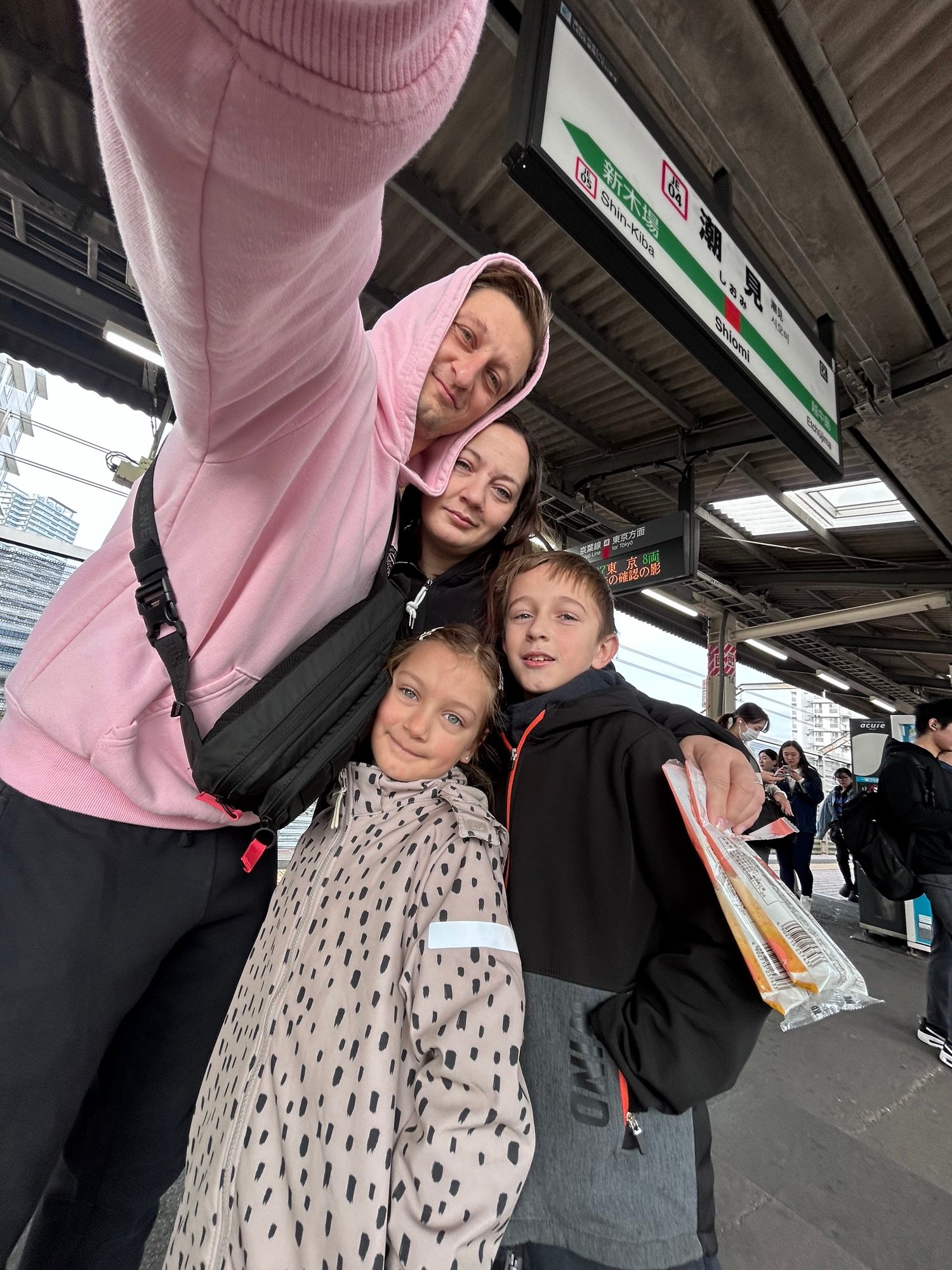
Because we stayed in Shiomi, we regularly used the JR Keiyō Line.
And the Keiyō Line platforms at Tokyo Station are far from much of the rest of the station.
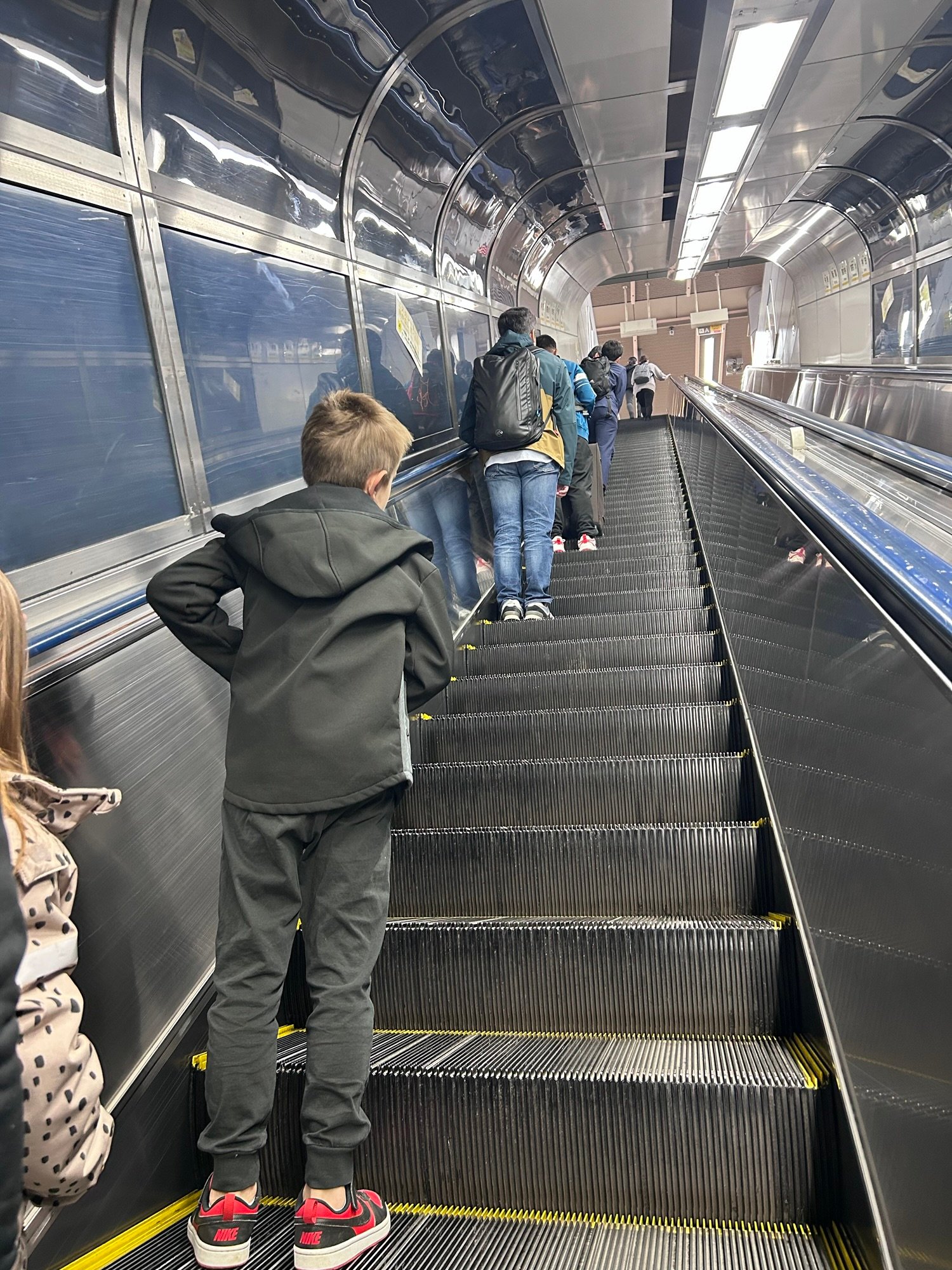
There were times when getting off our train and actually reaching the exit — or another line — took us around 10–15 minutes.
And that’s not just us being slow tourists.
JR East’s own station information gives a standard transfer time of 20 minutes between the Keiyō Line and the Shinkansen, compared with around 10–15 minutes for many other Tokyo Station connections.
So if Google Maps tells you:
“Change trains at Tokyo Station – 8 minutes”
and you’re travelling with kids…
I wouldn’t casually stop for coffee.
Our Tokyo Station rule
If your route involves Tokyo Station, give yourself extra time.
Especially if you’re:
- travelling with kids,
- carrying luggage,
- using elevators,
- connecting to the Keiyō Line,
- or catching a train you absolutely cannot miss.
Missing an ordinary Metro train doesn’t matter because another one will arrive.
Missing a reserved Shinkansen is a considerably less entertaining family story.
Shibuya Station: Somehow We Got Lucky
Shibuya has a reputation for being confusing.
Multiple railway and subway lines meet there, and there are numerous exits leading to completely different parts of the neighbourhood.
Somehow…
we found our exit almost immediately.
I still don’t know how.
Don’t expect this level of luck.
The important thing isn’t simply knowing:
Get off at Shibuya.
It’s knowing:
Which Shibuya exit do I need?
Tokyo Metro itself recommends checking the exit number for your destination and following the yellow exit signs and vicinity maps. The official guidance says exit signs are displayed in both Japanese and English.
Google Maps can often tell you which exit to use too.
Pay attention to it.
Coming out of the wrong exit at a huge Tokyo station can leave you surprisingly far from where you intended to be.
Where We Stayed: Tokyo Bay Shiomi Prince Hotel
Affiliate disclosure: This post contains affiliate links. If you book through one of them, I may earn a small commission at no extra cost to you.
We stayed at Tokyo Bay Shiomi Prince Hotel during our time in Tokyo.
For us as a family, the location worked really well.
Shiomi Station is nearby, and from there the JR Keiyō Line connects towards Tokyo Station. It’s also convenient when heading towards the Tokyo Disney Resort area — something that mattered because DisneySea was part of our trip.
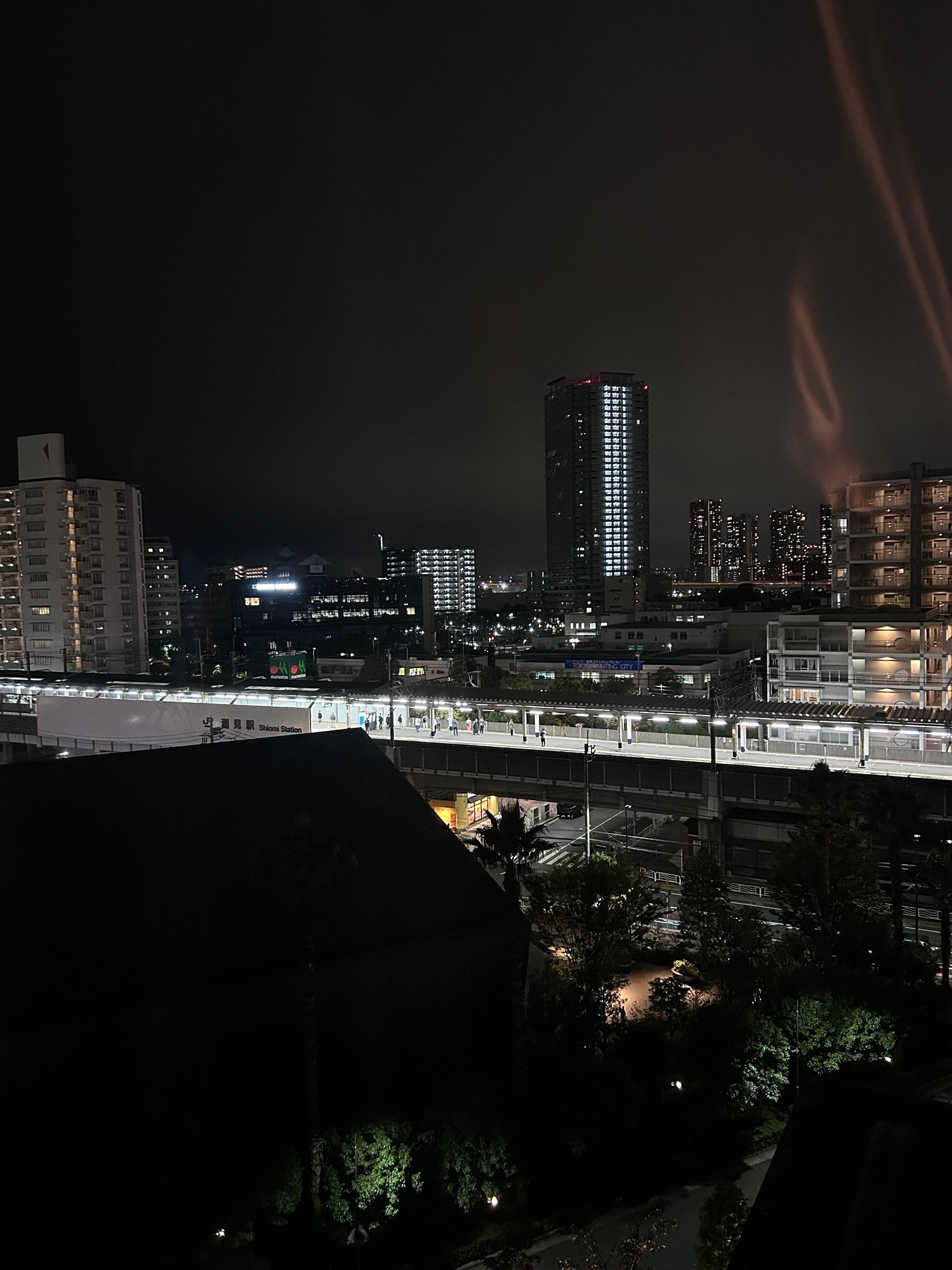
The trade-off is what I mentioned above: the Keiyō Line platforms at Tokyo Station aren’t particularly convenient if you’re constantly changing onto other lines.
But after a couple of days, we knew the walk and stopped thinking about it.
For us, having a comfortable family hotel away from the absolute madness of Shinjuku or Shibuya was worth it.
👉 Check prices for Tokyo Bay Shiomi Prince Hotel
Is Tokyo Public Transport Difficult With Kids?
Much less than we expected.
The hardest part wasn’t actually riding the trains.
It was navigating the stations.
Once you’re on the correct platform, everything is extremely organised. Tokyo Metro uses line colours, letters and station numbers, and platform signs show the direction of travel and major stops.
The moments requiring more concentration were:
Transfers. Some stations are enormous and two lines that look close on a map may involve a decent walk.
Exits. At stations like Shibuya, getting off the train is only half the job.
Rush hour. A packed Tokyo commuter train with tired children isn’t something I’d actively add to the itinerary.
Luggage. Elevators exist, but finding them can add time compared with simply following the nearest stairs.
Keeping everyone together. Four people tapping through separate ticket gates means it’s worth making sure the kids know to wait immediately on the other side.
Don’t Try to See Tokyo by Walking Everywhere
We love walking when we’re exploring cities.
Tokyo cured us of the idea that we could walk between everything.
Individual neighbourhoods are fantastic for walking — Shibuya, Asakusa, Ginza, Harajuku and so on.
But Tokyo itself is enormous.
Our approach became:
Train → explore neighbourhood on foot → train → next area.
That worked extremely well with kids and prevented us from wasting their energy walking several kilometres between places that weren’t particularly interesting.
Save their legs for exploring the places you actually came to see.
Do You Need a Tokyo Subway Pass?
Not necessarily.
This is where I’d avoid automatically buying a tourist pass just because you’re a tourist.
Your best option depends on your itinerary because you may use a combination of Tokyo Metro, Toei and JR trains rather than only the subway.
For us, the convenience of tapping an IC card and taking whatever route made sense was more important than trying to optimise every individual fare.
If your itinerary involves heavy subway use, then compare the current tourist passes against your planned journeys.
Otherwise, Suica + Google Maps is wonderfully simple.
Our Biggest Tokyo Transport Tips for Families
If we went back tomorrow, these are the things we’d do exactly the same — or learned the hard way:
- Use an IC card instead of buying individual tickets.
- Use Google Maps for every journey, even when you think you remember the route.
- Check the train destination before boarding. Ask us how we know.
- Look at station numbers and line colours, not only Japanese station names.
- Check your exit before reaching the station.
- Allow extra time at Tokyo Station, especially when using the Keiyō Line.
- Avoid peak commuter times where possible when travelling with kids.
- Don’t panic if you get on the wrong train. Get off and recalculate.
- Keep some money on your IC cards so nobody discovers an empty balance while the rest of the family is already through the gates.
- Let the train do the long distances and walk within neighbourhoods.
So, Is Getting Around Tokyo With Kids Easy?
Surprisingly, yes.
Before arriving, Tokyo’s transport network was one of the things I was most worried about.
By the end of the trip, using it felt completely normal.
The system is incredibly organised, Google Maps removes most of the guesswork, and an IC card means you don’t need to understand the fare system every time you travel.
You’ll probably take a wrong train eventually.
You might spend 15 minutes walking through Tokyo Station wondering whether you’re still technically inside the same building.
And you may emerge from Shibuya Station feeling like you’ve just completed an escape room.
But that’s part of Tokyo.
Don’t try to understand the entire transport system before you arrive.
Learn how to use an IC card, follow Google Maps, pay attention to line numbers and exits, and you’ll figure out the rest surprisingly quickly.
And if you do accidentally start heading towards Yokohama…
Well, apparently you wouldn’t be the first family to do it. 😂
Was this guide useful? Buy TravelDad a coffee. It probably won’t pay for the next family trip, but it might cover an airport coffee.
FAQ
Can you use Suica on the Tokyo Metro?
Yes. Suica and compatible IC cards can be used on Tokyo’s subway and many other trains and buses. You tap when entering and exiting, and the appropriate fare is deducted.
Do children pay for the Tokyo subway?
On Tokyo Metro, children aged 6–11 generally pay half the adult fare. Up to two toddlers aged 1–6 can travel free when accompanied under the conditions specified by Tokyo Metro; additional rules apply depending on how they’re travelling.
Is Tokyo Station difficult to navigate?
It can be, particularly when transferring between distant platforms. The Keiyō Line is especially far from many other parts of Tokyo Station; JR East’s published standard transfer times illustrate how substantial some transfers can be.
Is Google Maps good for Tokyo trains?
We found it extremely useful and used it throughout our family trip. I’d still check the train’s destination and station signs before boarding rather than blindly following your phone.
Is Tokyo public transport good with kids?
Based on our experience, yes. The trains themselves were easy; navigating huge stations, transfers and exits required more attention.
Continue Planning Your Japan Trip
- How Much Does a 2-Week Trip to Japan Cost? (Family of 4 Breakdown)
- DisneySea vs Universal Studios Japan: Which One Is Better? (Our Honest Experience With Kids)
- Tokyo itinerary with Kids: 3 Perfect Days in Shinjuku, Shibuya & Asakusa
- Japan for First-Time Visitors: An Ultimate Family-Friendly Beginner’s Guide
- 3 Days in Osaka, Japan – Our Honest Family Experience
- Kyoto with Kids: Our Honest 4-Day Kyoto itinerary (2026 Family Guide)
- Nintendo Museum Kyoto: Is it Really Worth Visiting? Our Honest Review (2026)
Discover more from Rok I TravelDad
Subscribe to get the latest posts sent to your email.




4 Comments